The Network
[ Architecture, Backbone network, Distribution network, Access Network, Local Network, Schools interconnection ]
Network Architecture 
During the network's design some crucial factors were taken into account that
affect its implementation and its future development. Special care was given
to users' specific needs, the interconnection speed and the basic and advanced
services provided to the users of the school network.
In Fig. 1 the Greek school network topology is shown. The dark color shows the 29 prefectures where the network has points of presence.
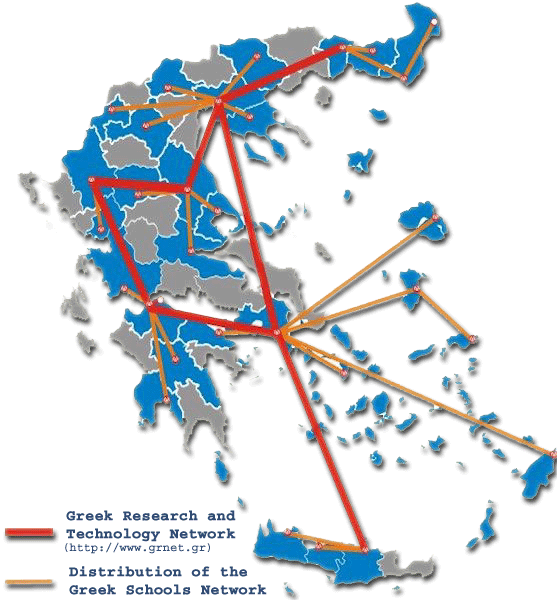
Figure 1: Map of the Greek School Network
The design model and the operational specifications of the Greek school network are based to the networking technology (Cisco, 1998) that has been developed in the framework of the wide extension of Internet in all over the world and is based on the Internet Protocol family, known as TCP/IP. The network's topology (Fig. 2) has hierarchical structure and consists of the following levels: Backbone Network, Distribution Network, Access Network and Local Network Units.
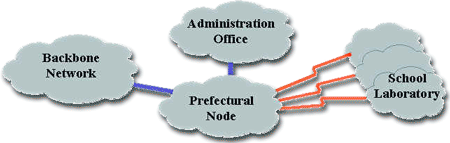
Figure 2: Architecture of the Greek School Network
Backbone network
The project does not develop a new backbone network but it uses the existing Greek
Research & Technology Network (GRNET, 2000) with 6 entrance points and total capacity
8.5 Mbps. The specifications of the backbone network provide the possibility to
create an efficient closed educational private network, which ensures Quality
of Service (QoS), security and integration in the educational procedures.Distribution network
Distribution network is the part of the network that interconnects points of
presence (nodes) with the backbone network. The topology has such design in
order to preserve the operational cost in low levels, which is particularly
critical in large geographical region networks. These points of presence (nodes)
are distinguished in two categories:
- Regional Nodes: Points of presence interconnected directly with the corresponding point of presence of the backbone network.
- Prefectural Nodes: Points of presence interconnected indirectly with the backbone network through connections with the nearest regional node.
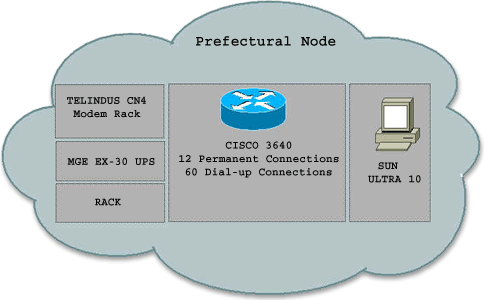
Figure 3: Regional - Prefectural Node
Access Network
The Access Network is the part of the network, which interconnects educational and
administrative units with the nearest points of presence. The types of interconnections
listed with decreasing order of the usage frequency, are:
- Digital interconnections using ISDN-BRI lines at the ends of the units (64 Kbps - 128 Kbps) and ISDN-PRI lines at the ends of the nodes.
- Leased interconnections using analog leased lines, 128 Kbps - 1.1 Mbps.
- Analog telephone interconnections using common PSTN circuits (56 Kbps transmission - 33.6 Kbps reception).
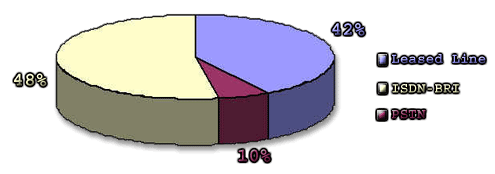
Figure 4: Circuit types of the Access Network
Two particular features of the Access Network, that give special significance to the Greek School Network related to other networks of commercial ISPs, are the following:
- In every educational or administrative unit corresponds a dedicated telecommunication circuit and port in the active network equipment, in order to ensure the availability of the network services.
- Even for the cases of non-permanent interconnections the initiation of the communication can be performed either from the side of the units or from the side of the node. By this way the network does not terminate in the points of presence but reaches inside the units.
Local Network
In school laboratories, computing devices and networking equipment (Fig. 5) are installed.
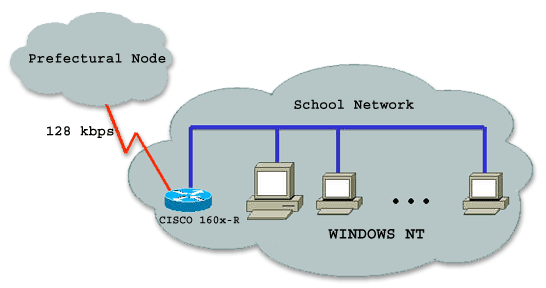
Figure 5: Interconnection of a School Laboratory
This modern equipment (installed by project "Mnistires") consists of a powerful server (with operating system Windows NT Server), approximately 10 multimedia stations (with operating system Windows 98), a color printer, a UPS unit and a backup unit (DAT). The local network of the school laboratory is realized by an Ethernet Hub (10BaseT). The networking equipment consists of one router (CISCO 160x-R) and in some schools (according to the telecommunication circuit) one Baseband modem.
The Secondary Education Administration Offices use more powerful networking equipment and interconnect through a high-speed line of 1,152 Kbps (Fig. 6). This equipment provides besides the basic network services, the possibility of voice transmission through the school network.
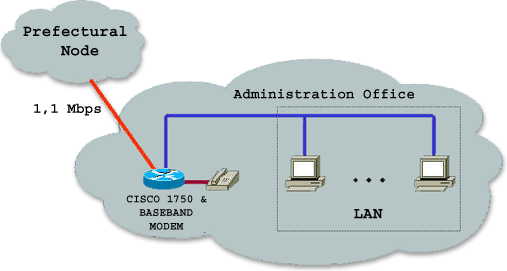
Figure 6: Interconnection of an Administration Office